第 16 章
Ravishri's Birth Chart
Birth Chart
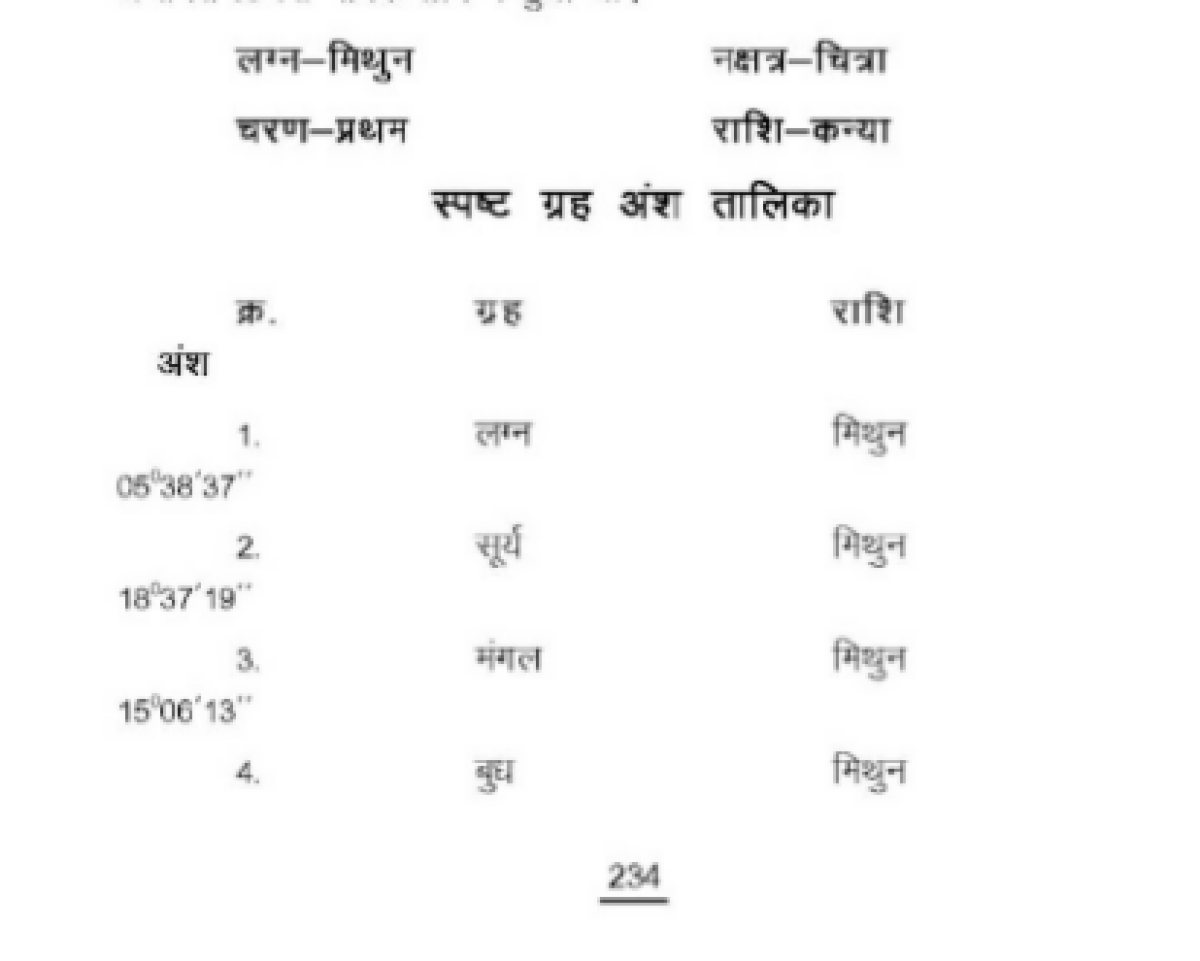
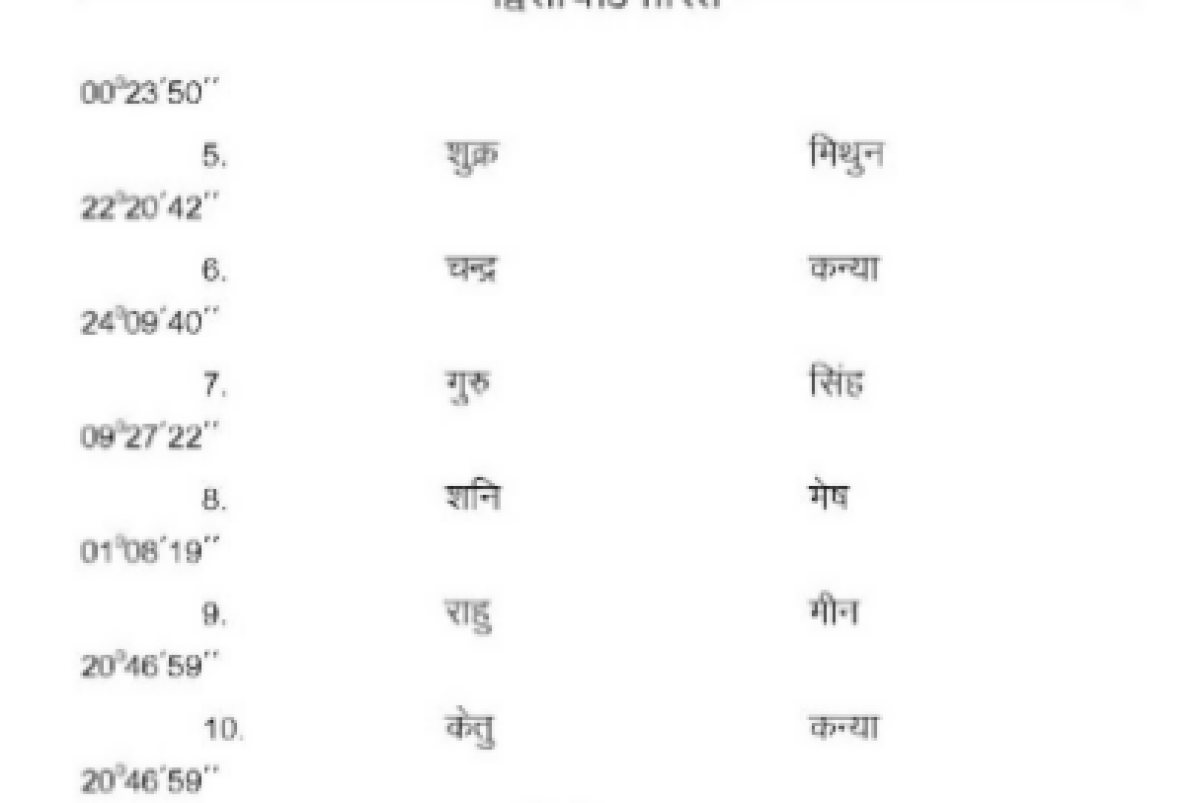
Saint Ravi Shankar Paramhans was born on July 5, 1968, during the transition period between Wednesday and Thursday, approximately one hour before sunrise, at 4:25 AM Indian Standard Time, in the village of Chhipri under the Jatara Tehsil of Tikamgarh district in Madhya Pradesh.
Interpretation
General interpretation of Ravishri's birth chart by the renowned astrologer 'Tripathi Ravindra Kumar Shastri' of Orai:
"Shri Ganeshaya Namah"
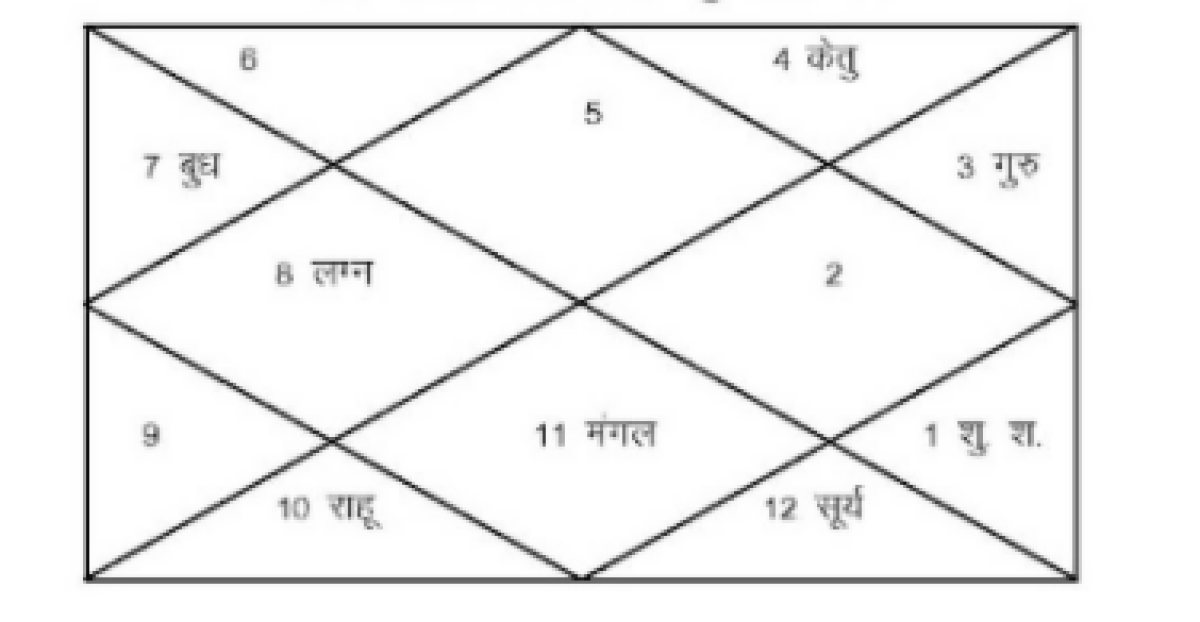
In the birth chart of Shri Ravi Shankar Paramhans, who is engaged in spiritual practice at the abode of Shri Rawatpura Sarkar, Pravrajya Yoga (renunciation yoga) can be clearly seen. In Ravishri's Gemini ascendant, there are four planets: Sun, Mars, and Mercury in the first house (ascendant), and Venus also in the first house. Jupiter, situated in Leo (the third zodiac sign), is in the fourth house (house of happiness). Moon and Ketu, situated in Virgo, are in the tenth house. Rahu is in Pisces, and Saturn in Aries is in the eleventh house (house of gains).
In the 15th chapter of "Brihat Jataka" composed by Shri Varahamihira, Pravrajya, i.e., Sanyasa Yoga (renunciation yoga), is described.
"The first verse is-"
एकस्थैश्चतुरादिभिबफलयुतैर्जातः पृथग्वीर्यगैः /
शाक्याजीविकभिक्षुवृद्धचरका निर्ग्रन्थवन्याशनाः //
माहेयज्ञगुरुक्षपाकरसितप्रभाकरीनैः ऋमात् /
प्रवज्या बलिभिः समाः परजितैस्तत्स्वामिभिः प्रच्युतिः //
The first verse is:
Eksthaishchaturadibhirmishraphalayutairjaatah prithagveeryagaih / Shaakyaajivikabhikshuvriddhacharakaa nirgranthavanyaashanaah // Maaheyajnyagurukshapaakarasitaprabhaakaraih kramaat / Pravrajyaa balibhissamaah parajitaih tatswamibhih prachyutih //
Translation:
If four, five, six, or seven planets are in one house, Sanyasa Yoga (renunciation yoga) occurs. The natives born under these combinations become, in order, followers of Shakya (Buddha), Ajivikas (an ancient ascetic sect), Buddhist monks, old ascetics, wandering mendicants, Jain ascetics, and those who eat forest produce.
The strength of the planets causing Pravrajya is equal to the strength of the lords of the signs they occupy. If the planets causing Pravrajya are defeated by their dispositors (the lords of the signs they are in), there will be a downfall from the renunciated state.
That is, if four, five, six, or seven planets are in one house, Sanyasa Yoga (renunciation yoga) occurs. In the aforementioned horoscope, four planets are in one house; hence, Sanyasa Yoga is confirmed.
Dr. B. V. Raman of Bangalore has written in the April 1991 issue of Astrological Magazine on page 330 that if the lords of the Moon sign and the Ascendant are in the same house or aspect each other, it leads towards renunciation.
In addition to the above Yogas, in the horoscope, the Atmakaraka (the planet with the highest degree) is the Moon, which is at twenty-four degrees, nine kalas, and forty vikalas in the Virgo sign and in the Leo Navamsa. The Atmakarakamsa Kundali (chart based on the sign occupied by the Atmakaraka in the Navamsa) is formed as follows:
।। Atha Atmakarakamsa Kundali ।। (Now, the Atmakarakamsa Kundali)
Translation:
In the Atmakarakamsa Kundali, Ketu in the twelfth house creates a yoga for Moksha (liberation). For Moksha, detachment from worldly bonds is necessary. If there was no feeling of detachment, how could he have left home at the young age of seventeen and come into contact with a detached saint like Deorah Baba? It is also noteworthy here that according to the Vimshottari Dasha (planetary period system) in the birth chart, it is seen that from the age of 17 years and 24 days, the Antardasha (sub-period) of Ketu in the Mahadasha (major period) of Rahu lasted for 1 year and 18 days; it was this period that gave the intellect to become detached from home.
In the same sequence, the state of Sanyasa (renunciation) was attained during the Antardasha of Venus. Venus is one of the four planets causing Sanyasa Yoga.
The presence of the Moon in Virgo gives simplicity of nature. The Moon in Virgo makes the native a worshipper of truth. With the Moon in Virgo, the native is a pleasant speaker, intelligent, and associated with the wealth and property of others. According to the seventeenth chapter, 'Chandrarashi Sheeladhyaya' (Chapter on the Nature of Moon Signs) of 'Brihat Jataka': "Sastraanshuvaahuh sukhi."
Veedaamantharaachaaruvikshanagatih
Shlakshnah satyaratoh kalaasu nipunah shastraartha viddhaarmikah ।।
Medhavi suratapriyah paragrihairvitaischa sanyyujyate.
Kanyaam paradeshagah priyavachah kanyaaprajoulpaatmajah ।।
(One with Moon in Virgo has delicate limbs, is happy, has a slow and graceful gait and beautiful glances, is gentle, devoted to truth, skilled in arts, knowledgeable in scriptures, religious, intelligent, fond of pleasure, associated with the homes and wealth of others, often goes to foreign lands, is a pleasant speaker, has daughters, few sons, and is self-esteemed.)
This Moon is situated in the fourth house; hence, it is also a Rajayoga (royal yoga) factor. In the context of renunciates, the fruit of Rajayoga is attained by becoming the head of a monastery or similar institution.
According to 'Gauri Jataka':
Chandraddashame sooryo janmakaale yadaa bhavet.
Raajamaanyo bahugnyaataa prasiddhih kula naayakah ।।
Translation:
That is, when the Sun is in the tenth house from the Moon at the time of birth, the native is respected by kings, knowledgeable, famous, and the best in their lineage.
The aforementioned Sun, being situated in the birth ascendant, indicates "Tanusthah Ravi tanguyashtim vidyate" – that is, a high nose, body, and forehead. A special result is that the Sun in the ascendant always creates a yoga for continuous travel. The Sun in Gemini gives the native divine vision, divine knowledge, and an amazing power to acquire all learning.
Mars being in the tenth house from the Moon gives happiness from vehicles and 'very abundant wealth', but Mars in the birth ascendant is also troublesome. Mars in Gemini makes one radiant and fearless.
Mercury, the lord of the Gemini ascendant, is situated in the tenth house from the Moon; hence, there is knowledge of pleasant speech, divine wisdom, and arts like singing and music. Mercury in the ascendant also destroys the malefic effects created by other planets; the body is particularly beautiful and healthy, but treatment becomes difficult if one falls ill. According to "Chandrat dashamage saumye rajayogi narah sada", Mercury is a strong Rajayoga (royal yoga) factor and also gives popularity.
For the Gemini ascendant, Jupiter, being the lord of the seventh house, is an obstacle. Jupiter in the third house obstructs the fortune of a native with the Gemini ascendant and does not allow attachment to anyone; hence, the native is inclined towards self-reflection. Jupiter being twelfth from the Moon is also a cause of opposition from family members. Jupiter situated in Leo attains the results of exaltation, and due to an abundance of courage, all obstacles related to fortune are destroyed.
The auspicious arrangement of planets in the tenth house from the Moon in the Gemini ascendant makes the physical appearance charming and the intellect an expert in arts, and confirms all the above auspicious results, and especially indicates longevity.
Saturn in the eleventh house (house of gains) is in its debilitated sign (Aries) and is in the eighth house from the Moon. Hence, it is troublesome for the father but auspicious as it causes expenditure in charitable and other good deeds and stabilizes wealth. The full aspect of Saturn on the planets causing Pravrajya Yoga in the ascendant indicates that complete detachment is attained during Saturn's Dasha (major planetary period), and a tendency to distance oneself from worldly beings may arise. Rahu and Ketu are in the tenth and fourth houses respectively; hence, they are troublesome for the mother and father. Anyway, what happiness can parents get from a son with a renunciate tendency? Rahu is an obstacle in the path of renunciation, and Ketu is a supporter. The above results clearly indicate that the results of the birth chart are those of a great soul. In the Atmakarakamsa, the Moon in Gauri (a specific planetary configuration) indicates devotion and also makes one knowledgeable in Sankhya Yoga, Mimamsa (a school of Hindu philosophy), and literature, and such a native also sings well or is a knower of the art of singing.
Mercury in Virgo and Gemini ascendant makes the intellect extremely sharp, and the memory is also particularly good.
In the presented horoscope, the following major Yogas are clearly visible:
- Bhadra Mahapurusha Mahayoga: Mercury being in its own sign (Gemini) in the ascendant is one of the five Mahapurusha Yogas, known as Bhadra Mahapurusha Yoga. Not only can this Yoga be clearly seen in Ravishri's horoscope, but other Yogas that make this Yoga even more influential are also directly present in this horoscope.
a. The Mahayoga named Bhadra Mahapurusha is even more influential in Virgo in addition to Mercury being in the ascendant.
b. In this Yoga, if Mercury is with the Sun, then Budhaditya Yoga helps in making the person's nobility famous far and wide. - Pataka Kalsarpa Yoga: When Rahu is in the tenth house and Ketu is in the fourth house, and other planets are between them, then Pataka Kalsarpa Yoga occurs. It is worth considering that the Moon moving ahead of Ketu in degrees and the presence of other auspicious Mahayogas make this only partially effective despite being a Kalsarpa Yoga. However, the occurrence of its effects cannot be denied. Its effects include separation from maternal and paternal grandparents and suffering due to separation from parents. Such a native always remains distressed. Especially the Dasha (major period) and Antardasha (sub-period) of Rahu and Ketu are not auspicious for the native.
- Vishishta Yoga (Special Yoga): If Mercury, even when combust (Asta) with the Sun at the time of birth, is in its own sign, the native is a distinguished scholar.
- Amala Kirti Yoga: This proven Yoga is formed when a specific planet is in the tenth house from the ascendant or the Moon, which is clearly visible in Ravishri's horoscope.
According to Shri Ravindra Dutt Shastri, an 80 percent similarity can be seen between the horoscope of Shri Ramakrishna Paramhansa and the horoscope of Shri Ravi Shankar Paramhans. Shri Shridharrao Agnihotri, about eighty-five years old, who was the Rajacharya (royal preceptor) and royal astrologer of Datia State, is renowned for his predictive astrology. He currently resides in Seondha, district Datia.
According to You:
First and foremost, highly extraordinary auspicious Yogas are apparent:
- Sharada Yoga: If the lord of the tenth house is in the third house, Mercury is in a Kendra (quadrant), the Sun, being the lord of the third house, is in the ascendant, Jupiter is in the twelfth house from the Moon, and there is a conjunction of Mercury and Mars, then Sharada Yoga occurs. As a result, the native possesses insightful understanding of progress and superior talent in solving social and worldly problems. (Devagya Manohare Gargavachana 68/6)
- Lakshmi Yoga: If the lord of the ninth house is in the eleventh house (house of gains) and the lord of the ascendant is in the ascendant, then Lakshmi Yoga occurs. As a result of this Yoga, the native themselves becomes a creator of pilgrimage sites. (Ratnamalaayam 207/44)
- Shri Nath Yoga: If the lord of the seventh house is in the third house, and the lords of the third, fifth, sixth, and the ascendant are conjunct in a Kendra or any other house, they bestow wealth and prosperity. (Jataka Bhusha Pra. Sam. 831 La. Sam. 28)
- Raja Yoga (Royal Yoga): If Saturn in Aries is in the eleventh house, Mars in Gemini is in the ascendant, the lord of the second house is in the fourth house, the lord of the tenth house is in the third house, and the lord of the fifth house is also in a Kendra, then this planetary configuration creates Rajayoga. Similarly, Mercury in Gemini in the ascendant and Rahu in the tenth house also create this Yoga.
In the same vein, the conjunction of the Moon in Virgo, Mercury in Gemini, and Mars in Gemini also creates this Yoga.
Kalatreshah + rajyesho, sahaje gatasyaaditi rajayoga dito - maneeshah
(Varahamihiracharya Smriti Chandrikaayaam 42/17)
Translation: As a result of the above Yoga, the native, even being a king, is renounced and devoid of worldly pleasures, possessing dominance and extraordinary splendor. - Physical Characteristic – Ajanbahu Yoga (Arms reaching the knees): This Yoga indicates the native's path of detachment from the previous two births and clearly points towards a native endowed with well-refined talents accumulated from previous births. Ajanbahu is considered its primary symptom and direct proof.
A life dedicated to helping others and the welfare of the world is the purpose of such a birth. This is not an innate achievement, nor a blessing given by anyone, nor can it be called accidental good fortune. The self-earned wealth of such a native, which they have already given away in previous lives, gradually returns; this is the effect of their past ascetic power. Such talents satisfy not only themselves but also those who come into contact with them. This Yoga is also a symbol of the native being self-sacrificing, and their thoughts, character, and behavior possess special uniqueness and are astonishing. The works of this native are extraordinary; an invisible divine power arises for the success of a divine purpose. In fact, they take a second or third birth to alleviate the distortions of the era. The ascetic power of previous births bestows a complete understanding of the ability for social welfare and eloquence without studying in school to acquire talent.
(Rajamartanda, Ratnamalaayam Pg. 158, Verse 19.23) - Samrat Yoga (Emperor Yoga) and Isha Pratinidhi Yoga (Representative of God Yoga):
Kendra trikone jeevecha (kevaa) bhanu bhargavayostanau.
Saumye bhogye yutih praapti - janmadway gato'pivaa ।।
Dharmaadhiyo gate laabhe laabhesh udayasthitih.
Udyaadhiyo kantakesho yadisyaatkantake sthitah ।।
Janmarkshaassikalaah shreshthaa, shubha graha yutaakshitaa.
Yadi aapoklam yuktaa sadhana yoga tatparah ।।
Punarjanmaaya jaataatmaa avataara sabhomatah
Nevertheless, based on this article, the aforementioned planetary positions are reflecting Isha Pratinidhi Yoga in the native's horoscope. And only a complete indication of two births is apparent.
(Prayog Parijaat 146/26, Garbh Gat Prakaran - Chapter on Past Births) - Adwitiya Yoga (Unique Yoga):
Udaye cha bhavane bhaumah somo patyena samyantah
Daityaachaaryena samyukto rajayogo vidheeyate
Result: If Mars is in the ascendant, the Moon is conjunct with the lord of the seventh house, and Venus is in association, then such a native possesses supernatural abilities and the power of retaining memories of past lives. (Smriti Chandrikaya Parashuraamena) - Analysis based on Bhadurish Rishi of the Bundelkhand region: Bhadurish Rishi was a profound astrological expert of his time in the Bundelkhand region, rich in the intensity of experience. Based on his principles, the analysis of the said horoscope is as follows:
Budh, Bhagu, Ravi Bhaumayut, jo kaountan mein hoy.
Rajayoga mahchaaniye, adwiteeya jan hoy ।।
(If Mercury, Venus, Sun, and Mars are conjunct in any house, recognize it as Rajayoga, and the person will be unique.)
Chauthe Chandra Budh raas mein, jo kahun baitho hoy.
Gurudev yadi teesre - iklo nrup sam hoy ।।
(If the Moon and Mercury are in the fourth house, and Jupiter is in the third house, the person will be like a solitary king.)
Shukra jo pahle bhavan mein dasmein Rahu hoy.
Teeje mein Guru ke gaye nischit raja hoy ।।
(If Venus is in the first house and Rahu is in the tenth house, and Jupiter is in the third house, the person will definitely be a king.) - Jo raviten ghar chaar mein, Sani ke Chanda jaay.
To va sut ki maat ke dooje Ravi ko dhaaye ।।
(That is, if the Moon is in the fourth house from the Sun and both are in the sign of Mercury, then the mother should understand that she has obtained a son as radiant as the Sun.) - Future predictions after observing the Dasha (major period) and Antardasha (sub-period) of this horoscope:
(1) The thirty-eighth year can be painful; however, with the grace of the revered Shri Vayuputra (Hanuman), the time will pass easily.
(2) At the age of fifty-six, mental transformation, the peak influence of Saturn in the third house with auspicious planets, leads to absorption in Brahma at a sacred pilgrimage site.
The Mercury Dasha leads towards Moksha (liberation), the Ketu Dasha to residing in a secret place, and Saturn in the third house, with auspicious Yogas, brings honor in an auspicious land at the age of seventy-six years and five months. One can take on the suffering of another devotee at this age, and if it is God's will, one can remain on Earth until the age of seventy-nine years and two months. - And finally: Under the year 1600, Abdur Rahim Khan-i-Khanan, a courtier gem of Akbar, was not only a politician but also a special expert in astrology, with a unique grasp on its predictive aspects. His extraordinary work was the book "Khet Kautukam."
Based on the said book, the analysis of the aforementioned horoscope is as follows. Based on the displayed Yogas, the confirmation of the planets at the time of birth proves accurate.
Here is the explanation of the astrological combinations described in the provided verses:
Verse 1:
- Planetary Positions: Sun in the Ascendant (महिल/लग्न, implying Aries as the first sign), Moon (महताब) and Jupiter (मुश्तरी) in Virgo (कन्या). These two planets (Moon and Jupiter) are mentioned as being in a trine aspect to the Sun's house (सूर्य के घर). Since the Sun is in the लग्न (Aries), its house is Aries. A trine from Virgo to Aries is not a standard trine (which would be to Leo or Sagittarius from Aries). However, the text states they are in a trine to the Sun's house while being in Virgo. This suggests a specific interpretive rule being applied in this tradition.
- Result: According to the verse, a person with this combination will be very wealthy (दौलतमन्द), have an army (लश्कराढ़यो), be charitable (बख्त-दाता - giver of fortune/luck), and long-lived (चिरायु). They are described as having abundant wealth (जरी जर्जरी).
Verse 2:
- Planetary Positions: Jupiter (मुश्तरी) is in a trine from a Kendra house (केन्द्र से त्रिकोण में). The Sun (आफताब) and Mercury (अतारिद) are both situated in the Ascendant (लग्न). Additionally, it mentions that the lord of the 9th house (भाग्य मालिक) is in a benefic house (भले घर).
- Result: This combination is considered highly auspicious (बख्त पूर्णः - full of luck/fortune). The person attains high status (रूतबा) and is described as potentially being a religious person (दीनदारो) or even a king (बादशाहो). The placement of the 9th house lord in a good house further contributes to accumulating wealth and living a life of ease, authority (बजीरी अमीरी - ministerial or noble status), and freedom from worry (बेफिकर).
Verse 3:
- Planetary Positions: Venus (चश्मखोरा) is in the Ascendant (लग्न खाने जमीबा). Jupiter (मुश्तरी) is in a trine from a Kendra house (केन्द्र खाने त्रिकेबा).
- Result: The verse emphatically states that a child born with this planetary configuration will become a king (बादशाही करेगा). The astrologer (ज्योतिषी) is depicted as confidently predicting a royal future for the child.
